Ungrateful? No, Inappropriate.

46493051_10217315486148757_3932569010809339904_n.jpg

A friend on Facebook posted the meme above today. It shows a child bending down to drink from a muddy and murky river. The caption reads, “Lord, if I’m ever ungrateful, forgive me.”

But something bothers me about the photo and caption.

I get why he posted it. He’s attempting to make a point about gratitude on this Thanksgiving week.

In one sense, I agree with the sentiment. Those of us who have plenty ought to be fully aware of the fact that there are millions of people in the world who are deprived of basic needs, including clean water. And we ought to be thankful that we don’t struggle to make ends meet.

Gratitude is about appreciating what one has, rather than lamenting what one doesn’t have. We are especially called to give thanks when we gather to celebrate with our families and friends this week.

Yet there is something fundamentally twisted and corrupt about this picture.

First of all, I am uncomfortable with the fact that there is a real human child in this photo. There is no way to know anything about where the picture was taken, who took it, and who the child is. If it’s a staged picture, then I am disturbed that somebody has faked the shot in order to make a point.

But if it’s a real-life situation, I’m bothered that a photographer took a picture of what is a truly desperate and dangerous moment. I want to know if the photographer approached the child after taking the picture and offered him or her a drink of clean water. I want to know if the photographer asked his or her permission to share the image with others. I want to know if the photographer profited in any way from the picture. If so, did the photographer share the profits with the child?

I’m uncomfortable with the fact that I have to refer to the child as only that — a child. I don’t know his or her name. The photo completely objectifies a precious human being, for the sake of making a point.

And what is the point being made?

That we should be grateful that we’re NOT LIKE THAT CHILD.

That’s what bothers me most. The caption tells us to give thanks to God that we have it better than others. And it attempts to shame us into this position of thankfulness by pointing out that there are people worse off than us.

Throughout my life, I’ve heard lots of people come back from mission trips and say things like, “I’m so glad I went to Far-Away-Third-World-Country because I realized how good I have it here at home, and I recognize that I need to be thankful for what I have and where I live.”

This line of talk has always bothered me. Because it makes mission about us, about “me.” I want to say in reply, “But what about them? In what way did you give hope to someone in despair? How did you feed the hungry, give water to the thirsty, comfort the hurting? Did you give anyone a reason to be thankful for YOU?”

Another thing that bothers me about the picture is the fact that it’s a black child. I recognize that the fact that the child is black doesn’t necessarily mean the picture was taken on the continent of Africa, but it seems clear that this is what is implied. The image plays on a stereotyped idea of Africa as a continent of great poverty, need, and deprivation — and ends up confirming the stereotype.

However, we should never forget that the problem of clean drinking water is NOT merely a Third World problem; look at Flint, Michigan, where water supplies only became safe a few months ago, after several years of dangerous lead levels.

The worst thing about this picture? I can’t imagine Jesus would have responded with platitudes about being thankful.

No, if Jesus saw a picture like this, I believe his response would be something closer to this:

“What’s wrong with you people? Why don’t you make sure every child of mine has clean water to drink? How can you enjoy your Thanksgiving meal when kids are drinking disease?”

I know that’s not what any of us want to hear on Thanksgiving, but it’s the truth of the world we live in.

And the only way to live faithfully in this world is to maintain an attitude of gratitude while, at the same time, working to relieve the suffering of the world’s poor.

But let’s not attempt to make ourselves feel better by saying, “There’s always someone worse off than me — thank you, God!”

How to Spend 52 Extra Hours

Thanks to Payton Climer for giving me this henna tattoo at the Pumpkin Patch to remind me of my stewardship pledge!

Thanks to Payton Climer for giving me this henna tattoo at the Pumpkin Patch to remind me of my stewardship pledge!

They say that good leaders don’t ask their followers to do things that they wouldn’t do themselves. That’s a rule I try to follow.

Thus, I have challenged myself to come up with an extra hour per week for service to God in the coming year, too.

I’d already decided that it was time for me to roll off the Refugee Services of Texas Board of Directors at the end of the year. I’ve been on that board for over seven years, the last two of which I have been President. I sense that it’s time for new leadership in that position. Besides, this last year was lots of work, given that I had to lead the way in hiring a new CEO for the organization.

It’s time to let some new people take the lead, and I gladly hand it off. My commitment to refugees and immigrants remains as strong as ever, but I’ll maintain that concern in a new way.

What will I do with my “free” time next year?

Glad you asked. I’ve agreed to two new responsibilities — see, that’s where the extra hour is going to be spent.

First, I’ve agreed to serve on the Lobby Corps for the Texas Coalition to Abolish the Death Penalty (TCADP), which is an organization I’ve been excited about for years. In fact, back in 2014, shortly before taking the pastorate at Kessler Park, I walked from the Dallas DA office to the Fort Worth DA office in one day with two other members of TCADP to deliver letters against the death penalty. Don’t worry — I’m not planning on repeating that stunt.

However, I do plan on making several trips to Austin during the 2019 Texas Legislative Session to meet with lawmakers about death penalty legislation. Over the last few years, fewer and fewer counties in Texas are pursuing capital punishment, and the tide has slowly been turning against the practice. Eventually, the death penalty will become obsolete in America again. I’m just going to do my bit in bending the moral arc!

And second, I’ve agreed to serve as the chair of the Crisis Management Committee for Faith Forward Dallas (FFD). FFD is an interfaith group which meets at Thanksgiving Square to unite faith leaders for justice and compassion.

My particular committee will be responsible for responding in times of crisis during 2019. When an act of injustice or tragedy takes place in the Dallas area, I’ll be contacting appropriate parties and organizing the faith response.

Both of these responsibilities are close to my heart and I look forward to sharing what I’ve learned with all of you.

I’m interested in knowing what you are planning to do with your extra 52 hours in 2019. If you are willing to share, leave a comment and let me know. Or you can send me an email or text message, and I’ll share in a future newsletter column.

52 hours is a lot of time — use it wisely!

Keeping Track of Your Time

In my sermon on Sunday, I challenged y’all to do a personal time evaluation. I saw a lot of blank stares when I talked about it, so let me explain what I was talking about:

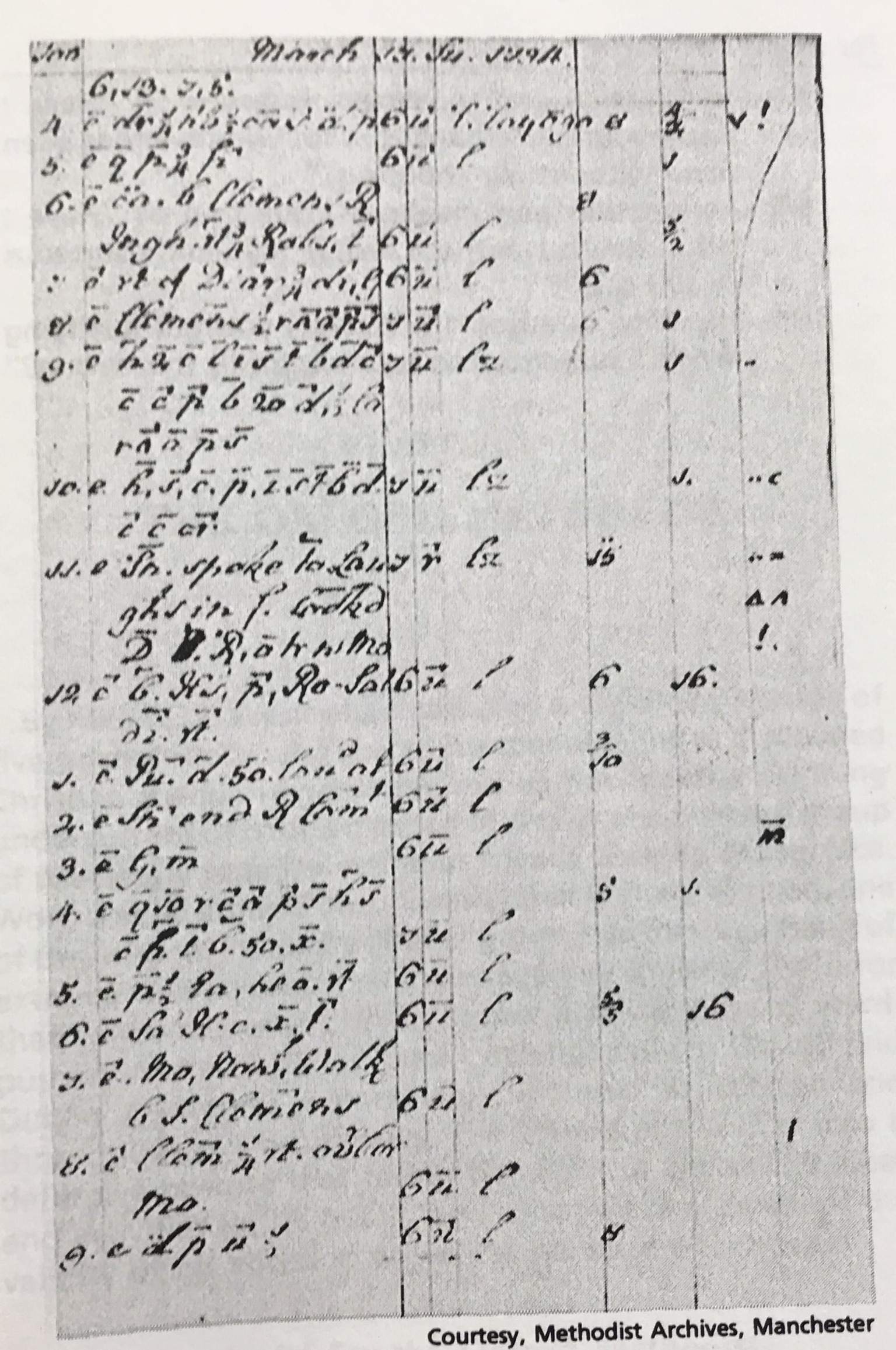
John Wesley’s diary from his time in Georgia; note the shorthand he uses to make his entries briefer.

John Wesley’s diary from his time in Georgia; note the shorthand he uses to make his entries briefer.

Start by taking a blank piece of paper. Write the time you usually get up in the morning at the top on the left of the page. Then go down the side of the page, listing each hour of the day until the time you usually go to bed.

My page, for example, would have 6 am at the top, with 7, 8, 9 and so on down the side until 10, which would be the last entry.

Then make copies of that page so that you have a week’s worth of pages.

Throughout each day of the week, keep a record of how you spend each hour of the day. Use whatever notation scheme you like. I actually write actual times in which I started a task, then the time when I did something else.

Don’t worry — this is only for your eyes. You don’t have to let anybody else see it. This is only for self-evaluation.

When the week is over, spend some time looking over how your time was spent and reflect. If it’s helpful, tally up the number of hours you spent in the big categories: work, sleep, family, rest and relaxation, church, etc.

Then compare those numbers and look for the surprises. Do you spend more time working than you thought? Are you getting enough sleep? How much time did you spend with your family?

Obviously, I want to encourage you to think about how much time you spent intentionally working on your discipleship. Did you spend time with God in prayer? Did you do any spiritual reading, either of the Bible or some other book that deepened your understanding of God? Did you have any deep conversations with others about things that really matter?

At this point, you may decide to stop reading this column in anger. “What right does he have to question my use of time?” you might think.

The truth is that the Methodist heritage contains a strong strain of Christian time management.

John Wesley was particularly concerned that he and his Methodist preachers managed their time well. In fact, he left behind a set of questions used to determine whether someone was fit to be of service. We call them the Historic Questions and use them in “examining” ordination candidates. The last of these questions, asked of every ordinand, reads like this:

Will you observe the following directions? a) Be diligent. Never be unemployed. Never be triflingly employed. Never trifle away time; neither spend any more time at any one place than is strictly necessary. b) Be punctual. Do everything exactly at the time. And do not mend our rules, but keep them; not for wrath, but for conscience’ sake.

If a preacher couldn’t honestly answer, “Yes,” Wesley wouldn’t commission him. And neither will our bishops.

A page from Wesley’s Oxford Diary; the entry for March 17, 1734.

A page from Wesley’s Oxford Diary; the entry for March 17, 1734.

Wesley himself kept to a very rigid schedule, as evidenced by the fact that he kept a detailed diary throughout his life. He didn’t do this because he wanted to leave behind a record of everything he had done; this was part of his own spiritual journey, part of the way he hoped to develop a “holy” lifestyle.

While attending Oxford, Wesley developed a rather intricate method for determining how well he was doing spiritually. First, he made up a list of 16 questions about his spiritual life. For example, one question was, “Have I prayed with fervor, by myself and at Chapel?” Another was, “Have I thought or spoken unkindly of or to anyone?”

Then he listed the hours of the day down the left side of his journal page, and made four columns across the top. In the first box, he wrote the details of what he had done at each hour. In the second column, he kept a record of his “Temper of Devotion,” which he kept on a scale of 1 to 9, with 9 being the most religiously devout and focused. The third column was labeled “Resolutions Broken,” in which he wrote down the number of any of the questions he had not kept; the fourth column was for “Resolutions Kept,” in which he wrote down the questions to which he could answer “Yes.”

If that sounds like a lot of work, it was. Wesley was unable to keep that up over his lifetime. However, it may also sound like an Obsessive-Compulsive Disorder! I like to think that Wesley gradually came to understand the meaning of grace and accepted the idea that he didn’t have to be perfect in order to be loved.

I’m not at all commending Wesley’s diary style to you. I don’t do it, and wouldn’t want to.

But Wesley certainly understood that the way we spend our time says something significant about our spiritual condition. What we do with our time says a lot about who we are, what we think of God, and how seriously we take our faith.

Let me close with this quote from Father Richard Rohr:

Time is exactly what we do not have. What decreases in a culture of affluence is precisely and strangely time—along with wisdom and friendship. These are the very things that the human heart was created for, that the human heart feeds on and lives for. No wonder we are producing so many depressed, unhealthy and even violent people.

What will you do to allow yourself to enjoy the gift of time once again?