
Courage

by Rev. Eric Folkerth

At our “Get to Know You” gathering Saturday evening, a member of the church shared that the thing that breaks their heart about the world a lack of empathy.

I said, “You’re in luck…the message for the week is about Compassion.”

We are living in deeply narcissistic times. Far too many of our leaders lead from their narcissism than from their desire to love and serve humanity.

Even worse, those of us in helping professions —teachers, counselors, ministers, and other public servants— feel as if our compassion wanes the more we reach out to serve the world.

As I mentioned on Sunday, we’ve got to show both self-compassion (to ourselves) and other-compassion (to the world). Jesus’ actions around the “Feeding of the 5,000” express this polarity well. He both meets human need with genuine compassion, and he also sends everyone away to spend some time alone.

When we show ourselves compassion —by eating well, exercising, seeing friends and engaging in renewing hobbies— we find our compassion for others expands. Far too many of us say terrible things to ourselves inside our own heads. We say terrible things to ourselves that we would never say to another human being.

This is not being compassionate toward ourselves. And if we don’t do that, we can’t really show compassion for others.

As you heard me say Sunday, this great Biblical word in the picture is the word for compassion. It means to experience a visceral and physical feeling of love, empathy, connection…with others. It’s felt in the *gut,* not just the head.

In a compassionless age, God needs us to practice outward and inward compassion. So that we might be lights of compassion to a world in desperate need of empathy and hope.
Fear Not

by Rev. Eric Folkerth

FearNot - 1.jpg

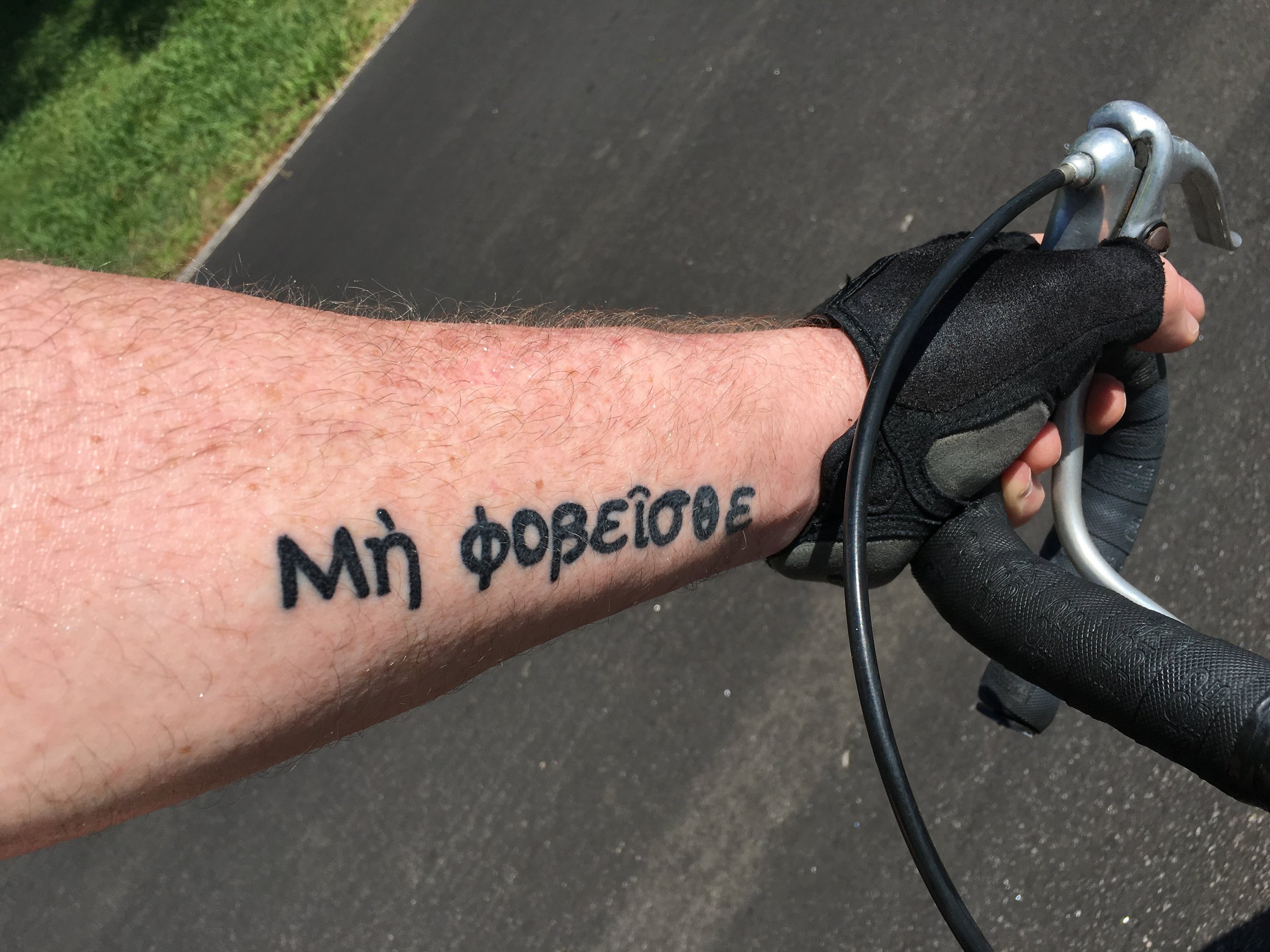
On Sunday, you heard me share about my tattoo of the words “Don’t Be Afraid,” in Biblical Greek. I shared briefly about what it’s like to walk around with that on my arm every day.

The truth is, some days it’s a great comfort, and other days it’s a judgment and challenge.

Some days, when I am deeply fearful about some personal or world situation, it’s very comforting to look down and see the words “Don’t Be Afraid” stitched into my skin. I allow the words to sink in, and I start to breathe easier and rest in God’s grace.

Other days, I am in the same emotional place, except when I look down at the tattoo, I have a very different reaction. It get angry with myself for ever having gotten the tattoo. I argue with the tattoo.

“I WANT to be afraid today…I don’t feel like being brave…Stop judging my fear…Just leave me alone…”

These are some of the things I say back to my tattoo.

What I’ve discovered, however, is that these things I am speaking are not simply to the tattoo, but really to God. Those excuses, rationalizations, and justifications are really prayers of a sort. Prayers lifted out of my own insecurities.

The key moment of change always comes when I slow down. When I remember Jesus’ words, when he said “Can you add even an hour to your life through worry?”

No. No, you can’t.

In fact, medical science has pretty well shown that, if anything, we can *shorten* our life through excessive worry and anxiety.

As we said Sunday, Fear is a pervasive human condition…which is why it is such a constant Biblical theme. God keeps reminding us to “Fear Not” precisely because God understands this natural tendency to fear.

A situation made even worse because of national leaders and news/social media which stoke our fears to keep us connected. We have leaders now who don’t *calm* our fears, or assuage them. They pile-drive our fears with a sledge hammer of terrifying rhetoric. Religion that stokes fear is not the true religion of God.

God calls us to be a people who overcome our fears, so that we can show the world the way to get over its fears. We’ve got to find ways to come together —across racial, economic, political, gender and sexual orientation lines— and live together as human species. My sense of our faith tells me that learning to “Fear Not” is a key message of it, and one we’ll come back to time and time again.

Don't Assume

by Eric Folkerth

DontAssume - 1.jpg

I shared this on Sunday, but it’s worth sharing again so we all can meditate on it more…

The very first piece of paper I printed out on the Kessler Park printer was the above page, with the words “Don’t Assume” written on them.

I taped it up on the wall, across from my desk, where I can see it even as I’m typing these words.

It’s an old and tired joke, I know…

“You know what you do when you assume…”

When we “assume” we know all we need to know already, we can make mistakes. We miss things. We can fail to hear important information that other people are trying to tell us. We can see people as being only our assumptions about them, and not see them as they really are.

So, as I continue to meet with our lay leadership and staff here at Kessler, I’m asking some very basic and simple questions like…

“How do we do this?”

“Who usually takes care of that?”

“Who are the stakeholders and volunteers involved in (fill in the blank) ministry?”

“Tell me about an average Sunday?”
“Tell me about an average week?”

I’m asking basic questions like this, not because I don’t know how to “do church.” I do know how. And not because I don’t have ways of doing all these things.

I’m asking these questions because I know enough to know that every church is unique and has its own culture; so before I can “lead,” I must “understand.” (The same goes for the neighborhood…)

And it’s interesting. As I ask these very basic questions, they often lead to greater conversations about who we have been as a church, and who we might like to be in the future. It seems to be opening up some thoughtful responses from many of our lay leaders and staff.

God calls us to see each human being, each church, as unique and special in their own way.

I like to call it “incarnational seeing.” Others call it “being mindful.” It’s sort of the same process, either way.

It’s slowing down…paying attention…not assuming too much.

Our “Listening Tour” gatherings will start soon. I am very much looking forward to them. Because they will be continuing times for us to share with each other, and to listen to each other, and to not assume too much about each other.

Out of that, great vision for our future will be revealed.

I can’t wait to see what our dreaming, and God’s moving, will lead us to do together.