
Finding Joy in “I Love You”

by Dr. Jonathan Palant

IMG_3692.jpg

I have really grown to love our family walks. The nearly three-mile route takes us through the neighborhood, around an elementary school, and back through a community park. Our kids, now seven and three, chase each other, race, and look for treasure under trees and on sidewalks. Last week, something happened on our walk that has had me thinking about the many lessons I’ve learned serving KPUMC these last ten years. 

About 15 minutes into our walk, a mail truck pulled up and the postman jumped out. Noah, our precocious seven-year-old, walked right up to him and said, “My name is Noah. What’s your name?”

 “Martín.” He said with a thick foreign accent.

IMG_3172.jpg

 Some talk ensued and Noah ended the conversation with an earnest, “I love you.” 

 As we walked away, I began to explain to Noah why this salutation is reserved for family members and those friends we consider to be our family of choice. As I was saying it, though, I started to question what I was teaching my son. I am certain I’ve heard more than one KPUMC senior pastor preach on the topic of ‘loving your neighbor as yourself’ and the passage does appear in both the Old and New Testament, but I began to wonder why we are instructed to “love thy neighbor” yet saying so aloud feels awkward and borders on inappropriate.  

 My assignment this week was to write a newsletter article on the topic of joy, and my inclination was to write how joy, much like fun, is a concept hard to define and even harder to predict and impart on others. To be honest, it wasn’t until Noah so carelessly and freely pronounced his love for the postman did I understand that joy cannot be programmed or imparted, but is instead something that happens organically and comes both when you expect it and also when you least expect it. Joy surfaces when a rainbow appears, when a favorite song comes on the radio, when a cherished memory emerges, and when a three-year-old princess-mermaid-unicorn named Caroline (my daughter) giggles uncontrollably. 

 All of these things bring me great joy, but they also bring me great hope. So, I wonder if joy and hope are synonymous in some way and, if so, if Noah’s innocent “I love you” to the postman might just be a sign that a new generation of those willing to love more generously is coming. 

 That would be joyous, indeed.
Peace

by Dr. Troy Doucet

On-The-Second-Sunday-In-Advent-The-Peace-Candles-Is-Lit.jpg

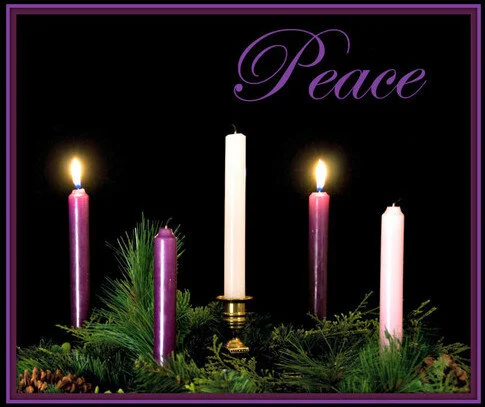
Christmas time is upon us once again. Of course, this year there is the obvious and proverbial "cloud" which hangs over this usually festive and joyous time. As we begin to think about advent and the lighting of our "PEACE" candle this week, there seems to be an incongruent sense of what reality is and where our hope resides. That is to say, while PEACE is longed for in our world by many, the world seems to manifest anything but PEACE at this time of PEACE. Disease, hunger, war, famine are all too consistent realities of our world that appear to be more perpetual than PEACE ON EARTH.

Yet, as we come into the second week of advent and as we focus our thoughts and prayers towards PEACE, it might be helpful to come to some more coherent understanding in situating PEACE as an authentic possibility and not merely one of potential hope.

PEACE cannot simply mean the absence of conflict and animosity or the avoidance of war or turmoil. Rather, PEACE in the New Testament is this Greek word (εἰρήνη), pronounced "Eirene" (we get the name Irene from this word). While there are multiple meanings and significations to this word, one of the most important definitions is this understanding that PEACE is an internal position of the soul's assurance and trust in God's provision that it manifests outwardly in one's life and being.

In other words, PEACE is NOT contingent upon the external circumstances-- but of one's inward harmony. I won't go so far as to say that PEACE, like happiness, is a "choice"-- but rather, that PEACE is something that is given not earned. PEACE, at least in the sense of how the Gospels employ this word, is a state of being where-- because of God's unending love for us-- we know that in the end conflicts will be resolved, that good will overcome evil, that LOVE WINS!!

This doesn't give us a license to sit on our laurels and wait for the magical appearance of "PEACE on earth"-- rather, it beckons us and calls to our deepest sense of longing and wanting PEACE to be known to GO and make PEACE with others and with ourselves. Why? Because we have PEACE first and foremostly with God. Christ's birth is the proof of this PEACE and the evidence of the coming of this PEACE that must first be rooted within us before it is ever manifested in the world.

Hope

by Ken Kelley

Advent 2020 Possible 2.jpg

In this year of 2020, the world anxiously awaits the coming of a vaccine for Covid-19. We heard it proclaimed that the vaccine would “be here by Easter,” and ever since, that it’s “just around the corner.” Now we have hope and reasonable expectation that, right in the middle of the Advent season, the first vaccine(s) will be approved and given to those in healthcare followed in due time by the rest of us.

I’m not sure exactly how the vaccine will be distributed, but many of us remember standing in line in the 1960’s to receive a sugar cube containing the polio vaccine developed by Albert Sabin. In 1955, the year before I was born, people began to receive a polio vaccine invented by Jonas Salk. These two people, along with the help of many others, found a way to prevent a disease which irreversibly paralyzes its victims leading to the death of 5% to 10 % of them. They had the audacity to dream of a solution to a worldwide epidemic and believe that they could make a difference. Jonas Salk put it this way, “There is hope in dreams, imagination, and in the courage of those who wish to make those dreams a reality.”

This Sunday, the first Sunday in Advent, we will concentrate on hope and celebrate our hope by lighting the first Advent candle, the candle of hope. Our hope is for today, tomorrow, and for all eternity. We anxiously await Christ’s birth in anticipation of the hope He brings to each of us and our world collectively.

We look backward at the arrival of the Christ Child for the first time and forward to Christ coming again to save us from ourselves. For our hope is more than just the hope that Salk expressed for us to live into our best selves. Our hope for the present is represented in the words in the last verse of “O little Town of Bethlehem” that we often sing as we celebrate Christ’s birth:

“O holy Child of Bethlehem, descend to us we pray;
Cast out our sin, and enter in, be born in us today.
We hear the Christmas angels the great glad tidings tell;
O come to us, abide in us, our Lord Emmanuel.”

Christ will only live in us if we invite him in and open ourselves to God’s direction for our lives. Only then will we allow Christ’s light of hope to shine in and through us as we serve as God’s vessels to bring God’s hope to those around us. We manifest this hope through our acts of kindness, words of encouragement, and by refusing to accept injustice in all its forms toward any of God’s children.

Although God calls each of us individually and all of us collectively as KPUMC to be catalysts of hope for our community, we must always remember the Source of our hope for today and for all our tomorrows. Sunday, we celebrate the hope of Christ coming again to fulfill all the hopes worth having that we’ll ever imagine and finally bring us to a place beyond our imagination. Stay awake! The Kingdom of God is at hand! As we wait, I pray that we will all experience a taste of that Kingdom as we share God’s hope with the world.

Ken