Sunday Morning is Not The Future of The Church

shutterstock_58194730.jpg

Sunday morning is not the future of the church.

I’ve come to this sobering conclusion only recently. It’s sobering because I have only ever known “Sunday morning church.” I grew up as a child attending Sunday School and worship every Sunday morning. Attending church on Sunday mornings was not optional in my family. It’s just something we did every week.

As a young married couple, Leah and I worked hard to find a church that we could attend on Sunday morning, no matter where we lived.

And as an ordained pastor, Sunday morning is viewed as the most important part of the week. It is the focus of our practice and faith. Here at Kessler Park UMC, a large part of the budget is spent on staff and resources which will be used on Sunday morning.

However, it is becoming apparent that the Sunday morning experience is in rapid decline, not just at our church, but at churches across the country. Look at our own numbers — our average attendance in 2018 is 108, down significantly from an average of 124 through the first half of 2017.

I don’t think this is necessarily bad news; our membership continues to grow, we’re financially stable and had one of our best pledge campaigns last fall, and we have active members. But our members don’t come to worship on Sunday mornings as regularly as they used to.

Why is that? How do we account for what Perkins professor Dr. Ted A. Campbell refers to as “the contemporary situation that active families do not consistently worship weekly as active members did earlier in the twentieth century”?  Why don’t they? I would argue because our lives are far busier and more complicated than in the twentieth century.

Today, like it or not, Sunday mornings are a favorite time to schedule youth soccer matches, baseball games, swim meets, dance practices, and a host of other activities. Parents who work more than one job often have only Sunday mornings free to spend time with their children. Families are often simply exhausted by Sunday; there is no other morning of the week in which they can sleep in, read the paper with a cup of coffee, and snuggle on the couch.

This doesn’t mean that these families have forsaken their commitments to Christ or the church; it simply means that they — and all of us — live out our faith in a different context. Every generation has to work out its own worship patterns and habits in its own context. In fact, the 11:00 am worship hour emerged in a 19th-century American farming context; that time was late enough in the morning to allow farmers to get their cows milked and morning chores finished before heading off to the service!

That’s why I think it’s time for the Church (by which I mean Christians of various stripes and sects) to recognize that Sunday morning is not the future. What I mean is that we should stop deceiving ourselves, thinking that if we only find the right formula, we can get large crowds back into church on Sunday morning.

The verdict is in — American culture has spoken. We don’t own Sunday mornings anymore. We’re not going to get crowds back into church on Sunday mornings.

That doesn’t mean we should stop having worship services on Sunday mornings. Many of you are in the regular habit of worship, which I highly endorse!

But if we’re going to peer into the future, and seriously consider what the church of tomorrow is going to look like, we have to reckon with the fact that it will likely coalesce around something different besides the hour-long worship service on Sunday morning. Furthermore, as we think about the task of creating new spaces for new faces, we will have to increasingly abandon the Sunday morning habits and rituals we have created.

We will have to consider different days and times to meet, based on the days and times that people are actually available to meet.

We will have to consider different places for people to meet, based on the spaces which are convenient and available.

We will have to consider different ways to worship, based on what makes the most impact in people’s lives.

We will have to reconsider how much money we allocate for Sunday mornings compared to other activities, missions, and ministries.

We will have to consider whether our precious programs and curriculum are necessary anymore.

We will have to rethink what we do in worship. Perhaps sermons aren't the best way to spend our time together.

This isn’t bad news, by the way. It’s simply a recognition of reality. The only bad news is what will happen if the Church (and our church) doesn’t adapt, doesn’t find a way to follow Jesus in this new context, doesn’t engage people where they are.

Jesus is moving on ahead, regardless of whether or not we follow. There will always be a Church; there will always be a community of faithful followers of Jesus.

But the time is coming when they may not meet on Sunday mornings anymore.


The Religious Preferences of Our Parish

oak cliff.jpeg

I’m still combing through the results of the demographic study provided by MissionInsite for United Methodist churches in the North Texas Conference.

Last week, I wrote about some of the stark numbers and facts about the people living around us. But this week, I would like to muse on what the study discovered about our neighbors’ thoughts about religion and church. (Remember, the study looked at the people who live within a 1.5 mile radius of our church.)

Regarding involvement in church, the percentage of people who consider themselves part of a faith community stands at 35.3%, which is higher than I expected. However, that number has dropped over 12 percentage points in the last ten years. That means over 47% of the population were involved in a church in 2007. That’s a huge drop in a short amount of time.

The only two categories of faith community which have grown considerably in those ten years are the “Nones,” or those who say they have no affiliation with any faith community, who make up 27.3% of the population, and those in non-denominational or independent churches, which make up 6.6%. The biggest declines were amassed by the Catholics, who are still the largest single denomination in our area, and the Baptists, the second largest. We United Methodists mostly held our own during this time, declining by only .6% in that time period.

When people who are not part of any church are asked why they don’t participate, here are their top five reasons:
    1. Religious people are too judgmental
    2. Don’t trust organized religion
    3. Religion too focused on money
    4. Disillusionment with religion
    5. Don’t trust religious leaders

Let’s stop right there and think about the implications of these findings. This tells me that there are a lot of people out there who have been hurt by church, who have been abused, manipulated, or denigrated by people claiming to be Christians. Our neighbors have some deeply-felt pain, and much of it is our fault.

As I said several times in my sermon on Sunday, our Bible has been hijacked. It has become a weapon in the hands of some, and the consequences are that some people have been beaten up, wounded, and bruised.

This should be a wake-up call for us. Fifty years ago, the culture around us was sympathetic to the church. Pastors were seen as civic leaders; Sunday mornings were sacred time, as well as Wednesday evenings; and people kept up a veneer of religiosity in the community. But that’s not the way it is anymore.

The study recommended, in a context such as ours, the following top five ministry or program preferences:
    1. Warm and friendly encounters
    2. Quality of sermons
    3. Adult social activities
    4. Opportunities for volunteering in the community
    5. Holiday programs and activities

Another interesting discovery was that traditional worship ranked #7 in this list, higher than contemporary worship, which came in at #17.

Looking carefully at this list, I believe that KPUMC is uniquely positioned to prosper in this community. Though I can’t speak to #2, I think we do quite well on these top five priorities, with the exception of #3. We still lack in the number of quality adult social activities that we offer, but I believe the Vision Task Force has given us a way to improve in this area.

Ultimately, however, the study fails to identify what is most important about a church, and what a church represents. One of the categories ranked “Life Concerns” for people in our community. Answers included such concerns as “losing weight/diet issues,” “day-to-day financial matters,” and “being successful.” Nowhere did I see the choice, “becoming a disciple of Jesus Christ.”

The one thing that KPUMC has to offer that makes us different from other organizations, non-profits, and institutions is that we help people become disciples of Jesus. We are in the business of transformation, of change, of life formation, of training in the art of becoming like Jesus.

Admittedly, not many people out there would articulate this as a life-goal. I would suggest that’s because they don’t know much about Jesus yet. They must not know about Jesus' sacrificial love, his fierce justice, his courageous opposition to the powers-that-be, his compassionate concern for the marginalized.

Let’s change that, shall we?

Getting to Know Our Parish

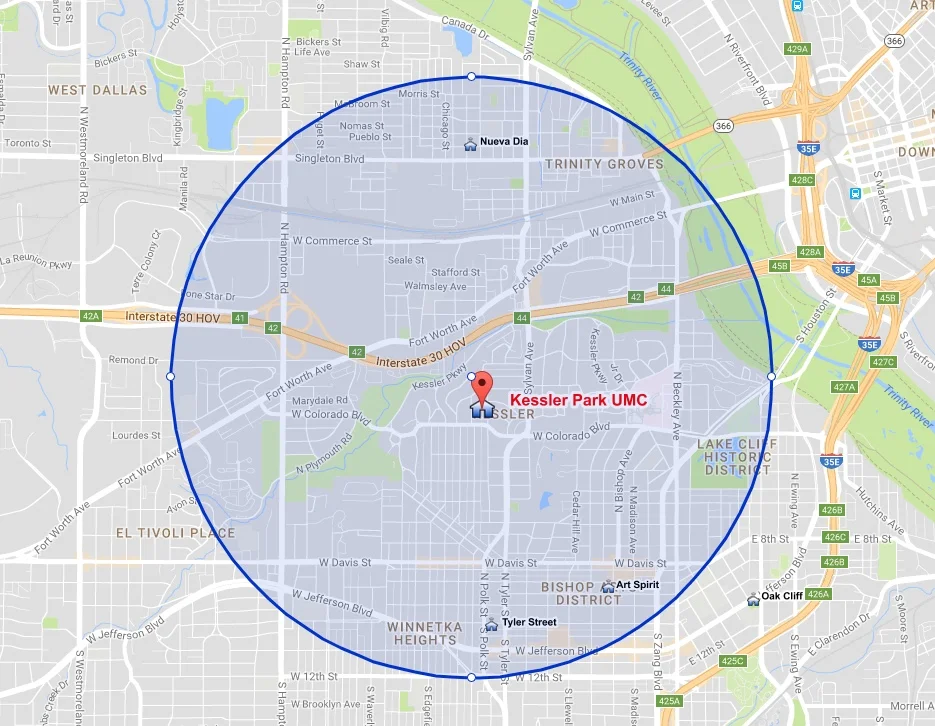
Radius.jpeg

Last week in this column, I shared the focus of the 2018 North Texas Annual Conference: “New Faces, New Spaces.”

The conference sparked my own interest in thinking about what it would mean for Kessler Park UMC to intentionally reach out to the new faces around us, and I posed the following questions: “Can we make space for the new faces? Do we need to create new spaces? What do we have to offer the people of Oak Cliff?”

Before we answer these questions, however, it is wise to ask a more basic question: Who are the people who live around us? What do they look like? What do they do? What kind of families are they in? How old are they?

Fortunately, the North Texas Conference makes available (for local churches) free access to the demographic findings of MissionInsite, a group which does extensive analysis of neighborhoods for churches and non-profit organizations. With just a few clicks, I was able to pull incredibly detailed information about the people in our part of town.

Over the next couple of weeks, I want to share some of the findings revealed by MisisonInsite. Before I do, I want to emphasize two things: first, demographic studies are no replacement for the work of spiritual discernment. Looking at numbers on pages does not excuse us from doing the hard work of getting to know real people in our neighborhoods and listening to their concerns. Demographics are nothing but indicators that might guide or point us in the right direction, but they cannot replace relationships and prayer.

Second, demographic projections are simply that — projections. They are not fact. They cannot be relied upon to give us 100% accurate pictures of the future. There are an unknown number of variables that go into the reality of neighborhood development and growth. Just because a report predicts that a particular type of people are going to move into a particular neighborhood in the next five years doesn’t make it so.

Again, I must stress that the usefulness of such numbers is simply limited to helping us orient ourselves to our own context and mission field. I always look for the things that surprise me, rather than the things that confirm my common sense observations. This is where demographic studies can be so helpful and enlightening.

This week, I would like to share some of the things that grabbed my attention upon reviewing basic demographic information about the people who live around Kessler Park UMC. My search area was restricted to a 1.5 mile radius around the church; this extends to Trinity Groves in the north, 12th Street on the south, a few blocks west of Hampton in the west, and just shy of I-35 on the east side.

One of the first things that struck me was the fact that there are at least three very distinct people groups in this radius: we are surrounded by mostly Hispanic neighbors (67% of the population, which is predicted to remain steady over the next five years), but our immediate neighbors are wealthier whites who are either at, or near, retirement. Furthermore, there is a ring of young singles moving into those apartments; they are mostly in their twenties, and they are a highly diverse racial group.

Overall, the population in this area is not projected to grow dramatically: in 2000, 38,600 lived within 1.5 miles of the church. By 2010, this number had dropped to 31,223, and is slowly moving upward since. Currently, 34,214 live here, a number which is only expected to grow 4.8% in the next five years.

Unsurprisingly, the two age groups which are expected to gain the most percentage-wise over the next ten years, are ages 18-24 and people 65 and older.

I realized that the exact location of KPUMC shields us from recognizing the great diversity in our immediate area. We are located in a beautiful, upscale neighborhood with rolling hills and carefully-groomed trees, and homes that are easily worth over half a million dollars. Yet compared to the entire state of Texas, the number of families living in poverty in the search area is significantly higher than the state average!

The estimated current average household income is $74,275, and this is expected to grow almost 14% over the next five years, but the growth appears to extend mostly to white families. In 2017, the median income of white families is $89,285; but for Hispanic families, the median income is $39,267, and only $29,347 for blacks.

Furthermore, the overall educational attainment of adults in this community is lower than the state average.

Remember these numbers apply to the people who live within a 1.5 mile radius of the church! This is what our parish looks like. This is the reality of the people whom we have been called to serve, give hope, and inspire.

This is a hard and complex question, but it doesn’t hurt to wrestle with it anyway: why doesn’t our congregation look more like the people in our area? Do we have all three distinct people groups represented in our church? Why not?

I also learned that the level of religiosity is “somewhat low” compared to the state average. But that’s a subject for next week’s column …