My Useless Protest

protest.jpeg

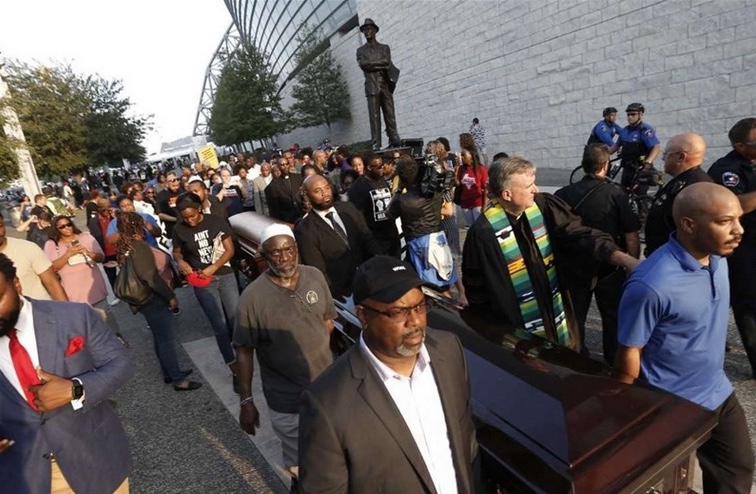
Some of you might have caught a glimpse of me on the ten o’clock news on Sunday night. I took part in a demonstration outside of Cowboys Stadium with conducted a mock funeral in honor of two men recently killed by police officers — Botham Jean and O’shea Terry.

We wheeled two caskets up to the stadium. I was one of the pallbearers, dressed in my clergy robe and stole, along with a number of other pastors. A crowd of laypeople followed as mourners.

My friend, Rev. Dr. Michael Waters of Joy Tabernacle AME opened the service and gave several pastors an opportunity to pray, including Imam Omar Suleiman, another friend. Rev. Freddy Haynes of Friendship West Baptist Church gave the eulogy. Then we knelt in defiance of Jerry Jones’ insistence that his players always stand during the singing of the National Anthem. And then we left, as quietly as we arrived.

While at the stadium, I texted a longtime friend of mine. He’s always amused at my rabble-rousing. Here’s how part of our brief exchange went on Sunday evening:

Me: I might get arrested tonight.

Him: Why this time?

Me: (sent two photos of our procession)

Him: Useless protest

Useless protest?

I understand his complaint. If we measured street protests by the visible and discernible effects of such displays, then we might conclude that most protests are useless. And our little march on Sunday night was useless, in the sense that I doubt Jerry Jones was even aware of our presence. I am quite sure that neither Mayor Mike Rawlings nor Police Chief Renee Hall will make any decisions as a direct result of that event. I am not convinced that it will have any impact on the rapidly unfolding events in the Botham Jean investigation.

I can look back on a lifetime of showing up for protests and seeing very little results. After all, I remember marching against the very first Iraq war, back in 1990 in downtown Los Angeles. We went to war anyway.

Then again I marched in the gigantic downtown Dallas protest against President George W. Bush’s Iraq war many years later. That time, I was convinced that we could actually prevent the coming invasion. We went to war anyway.

I have appeared at various immigration rallies, against the Muslim ban and against family separation. Nothing has changed. I marched in the recent student march against gun violence, and even led a prayer vigil outside of the NRA convention this past summer. Nothing has changed.

So yes, protests and marches are “useless” if you’re looking for a quick result. They are a waste of a perfectly good evening if you want an immediate change.

I had to think seriously about whether I wanted to spend my Sunday evening outside of the stadium, or on my couch watching the game.

Yet showing up in the streets is not simply about forcing results. Protest is a complex animal. There are many good reasons to march in the streets. One reason I attended the Botham Jean protest was to show solidarity with African-American clergy. Police brutality affects their constituents much more directly than mine; when the shooting of an unarmed black man occurs, it is an existential crisis in their communities, not mine.

I am also acutely aware that, when a police officer shoots and kills an innocent victim, white folks are far more likely to trust the criminal justice process. African Americans and Hispanics feel quite differently. Their history has taught them to be wary of the process. I don’t understand this suspicion, so I try to put myself into situations where I can feel it for myself.

After spending time talking to the attorney for Jean’s family, and some of the clergy at the march, there are significant questions about the police department’s handling of the case. It’s clear that some media outlets in town were complicit with the police in releasing information about Botham Jean that would tarnish his reputation on the same day that his life was being mourned by hundreds of friends and family. My black colleagues taught me that this is common in these situations: “First, they kill the body. Then they kill the name.”

After the march, we all went home. Nothing changed.

Yet everything changed. I came home different. I came home with a new empathy and sensitivity for the situation of the African-American community in today’s America.

Let’s also recognize that thousands of people witnessed the weird sight of pastors pushing two caskets through the parking lot outside Cowboys Stadium. I anticipated that we might receive some hateful stares, rude gestures, or even some shouted curses.

Instead, people seemed to stop and stare reverently. Lots of people pulled out their phones to record the event. Some raised their fists in solidarity. Others said, “Thank you!” and “Amen!” They seemed to understand, if only momentarily, that there are some things going on in Dallas that are more important than a football game.

The action was seen by a larger group than even the fans who were present; video of the march was shared on social media, most of the local news stations covered it, and I can’t help but think that some people were talking about it around the water cooler this morning.

Then again, maybe it doesn’t really matter if it was “useful” or not. There is something valuable simply in the fact that it happened. A good protest is like a ritual; the value of it lies largely in doing it. It is a performed action, and it doesn’t depend on how many people participate in it.

A good protest is like Holy Communion, which is one of the most “useless” things we do. Think about it — we take a little crumb of bread, which doesn’t actually satisfy any part of our appetite, and we drink a few drops of grape juice, which is hardly enough to wet our throats. We’re supposed to believe that Christ is present, but there’s never any visible evidence that he actually shows up. And nothing changes because we’ve taken Communion; the world is still evil and broken. If an outsider were observing a Communion service, she might say, “Well, that was pointless.”

But you and I wouldn’t say that, would we? Because we participate in it. We eat the bread and drink the cup. We act in faith. We know in that holy moment that nothing changes … and yet everything changes.

That’s how I feel about Sunday night. It was glorious.

Being the Driver

bobs-burgers-my-fuzzy-valentine-bob-driving-the-kids-2400x1350.jpg

by Kurt Maerschel

Recently I drove home from a class which I am taking at SMU Perkins School of Theology. The class is titled “Prayer and Spirituality.” It is a 3 hour class which meets Monday evenings from 6:30 pm to 9:30 pm.

Part of class time is “to do nothing.” That does sound funny but is much harder than one would think. We sit around in silence trying not to think about anything, but to simply be. I have practiced this for a while now and from time to time I did have what I would call an “epiphany moment.” When we are silent and step out of “clock time” into what I like to think of “transcendent time,” we are more open to connect with God.

But why is this so? This is where I had to circle back to my thoughts about my drive home from class. I am the proud father of four kids, fifteen and under. I spend an extraordinary amount of time in the car driving them from activity to activity, either picking them up or driving them to a sports game, a birthday, girl scouts, boy scouts, camp, band, gymnastics meet or simply to get some ice cream. I love my kids and I want to give them the best childhood that they can have, including all the activities they love to be part of. I am in charge of getting them from point A to point B. I need to keep them safe. I need to make sure they get there on time. In between I am asked to change radio stations, no matter whether I am in the middle of a merge on I-635 or not. However, when driving, more often than not, the kids simply stare at their screens or are busy choosing songs to play over the car stereo. When they get in the car first, I ask them excitedly how their day was because I want to be part of their lives. Most of the time I get a “fine” and an “I’m hungry.” Thereafter we move on to picking songs on the stereo or staring at their screens.

No matter how hard I try, the kids fall back into this same tired old routine. I get it, too. They come from school and are finally happy to kick back and relax. The last thing they want to do is to tell this annoying parent what they have been doing all day long. So in the end I am relegated to being the driver. The kids are totally oblivious of what is going on in the outside world. Once we reach our destination they get out and happily do whatever they are there to do. Most of the time I have to order them back to the car to get their stuff out, but sometimes I am just too tired.

I believe that God often feels like the “driver” in our lives. We are busy, not noticing what is going on around us. We take it for granted that we arrive safely somewhere. We get annoyed because the radio does not play the music we want. We get annoyed in the rain, when it takes forever to get anywhere. Often we simply say “hi,” or “my day was great,” or “I am hungry,” and then continue on our smartphone ignoring everything around us. God is not pushy, God is patient and drives us through our lives. Without ever stopping and listening to God we often simply get annoyed, disappointed, desperate, discouraged and lonely in our self-created bubble of distraction. God wants to share community with us, every day all the time, but for this to happen we sometimes simply need to stop and “do nothing.”

If you want to know more about doing nothing please feel free to talk to me in person, by email or by phone. Kurt Maerschel kurt@kpumc.org 972-835-1909.

Landing On Your Feet

After Vacation Bible School this summer, Rev. Kay gave me a gift. It’s a little wind-up plastic monkey. When it’s wound up, it does backflips. Backflips!!!

And here’s the amazing thing — it lands on its feet every time. EVERY. TIME.

It’s become my favorite desk object.

Anytime I go through a rough patch, I wind that monkey up and watch him flip. I’m always amazed that he lands on his feet. In fact, there’s always a little bit of dramatic tension just before he jumps, because I worry that maybe this time he won’t make it.

But he always does.

I don’t know how he does it. Yet that’s how I want to be.

I always want to land on my feet. I never want to be brought so low by a circumstance or piece of news or life situation that I can’t get back on my feet and keep moving forward.

Compared to most people, I am extremely fortunate. I have been blessed with good health, and my family and friends have, too. My parents are still alive, and I’ve never lost anyone close to me yet. I have always had employment, and I’ve never worried about feeding my family. We’ve always lived in a secure and stable environment, and we’ve reaped multiple benefits from being American citizens.

However, I have had professional disappointments. Having to leave Cameroon was the most difficult thing I have ever had to do, and it caused me some personal distress. It took me several years to get over the pain of leaving early.

Somehow I “landed on my feet,” and regained a sense of purpose and meaningfulness again.

After leaving Cameroon, I experienced another major disappointment in my appointment to the church in Rowlett. As I rebooted my pastoral ministry in America, I ran into another obstacle when part of the congregation resisted my interactions with the Muslim community, as well as some of my public social justice work.

This, too, took the wind out of my sails, and I found myself reeling yet again.

But I “landed on my feet,” and found myself with the appointment of a lifetime — Kessler Park!

Ministry isn’t easy, of course. The grind of church politics and administrative minutiae sometimes makes me want to reconsider my life choices, but in the end, I come back to the call of God on my life. I remember that I am tethered to that call, and that it gives me meaning and purpose.

One of the Scriptures that has helped me “land on my feet” time and time again is a story at the end of the Gospel of John. Poor Simon Peter denied knowing Jesus three times on the night of his arrest, and he is still wrestling to absorb the fact that Jesus has risen from the dead. He finds himself sitting on the beach, when Jesus leans over and asks him, “Do you love me?” Peter is quick to respond, “Yes!” Jesus says, “Then feed my sheep.”

This exchange takes place three times. Each time, Jesus’ question is met by Peter’s “Yes!” Each time, Peter’s “Yes!” is met with Jesus’ command to feed his sheep.

Jesus concluded the conversation by saying, “Follow me.” Peter did, and it’s fairly obvious that he landed on his feet quickly. He weathered the personal storm, the shame of having denied his Lord, by becoming the de facto leader of the nascent Christian movement. He got on with the business of feeding the sheep, of leading the flock with a gentle and deft touch.

Every time I feel shame and insecurity, I imagine that Jesus is asking me, “Do you love me?” I always answer, “Yes of course, you know I do!” And he always replies, “Then feed my sheep, and follow me.”

You have to be on your feet to follow Jesus. That’s why I’m confident I’ll always find myself standing in the end.