
We All Need New Reading Glasses

shutterstock_1165497142.jpg

I don’t have a particularly good history concerning my eyesight.

I have always been terribly near-sighted. I started wearing glasses in third grade. It was a traumatic experience to walk into the classroom for the first time. I wouldn’t call it “bullying,” but I was called “four-eyes” more times than I cared to hear. It wasn’t helpful that my parents didn’t give me a style choice — I was stuck with black, horn-rimmed glasses all the way through high school graduation.

In college, I finally upgraded to contact lenses, which helped my dating life considerably.

When Lasik surgery came around, Leah jumped on the bandwagon, but I was hesitant. I simply didn’t like the idea of having my eyeballs sliced and diced. So I waited.

Then on a fateful trip to Vietnam in 2010, I found myself on a bus en route to the Mekong Delta. I closed my eyes momentarily and leaned against the window when we hit a huge pothole. My head slammed backward against the seat.

Later that night, I noticed that there appeared to be a growing black hole on the left side of my vision field. When I arrived back in Dallas a few days later, Leah drove me directly to an eye specialist who confirmed that my retina had been detached by the impact. I went immediately into surgery.

Though the reattachment was successful, I have never had perfect eyesight in the left eye since. I have lost quite a bit of my peripheral vision, and hard edges appear wavy, as if I have plastic wrap stretched over my eye.

And more recently, I’ve started to wear reading glasses on a regular basis, which I’m sure you have noticed.

So I understand that, in order to see things clearly, to view reality correctly, your eye must be clear and unhindered, free from distortion. Unfortunately, I will never be able to see things perfectly clearly — I will always see things through a retina that imperfectly stretches across my line of sight, and I increasingly see things through glasses, which are frequently smeared and dirty. At best, I am like the Apostle Paul, who said, “I see things now as through a glass darkly.”

That is also true about the way I read the Bible. I recognize that I do not read Scripture from a completely objective and value-free point of view. Nobody does. All of us come to the Bible and read it with our own wavy retinas, scratched glasses, and imperfect understandings.

This is not an excuse NOT to read it. No, even read poorly, the Bible is still an instrument God uses to touch hearts and move souls.

But this is the only way we can read the Bible. It’s impossible to read it any way except from the perspective of who you are, in the light of your own experience. There is no way to read anything at all without projecting something into the text. This is what we do when we read novels and poems and newspapers, and it's true when we read Scripture, too. It’s the way all people read.

However, this reality should make it clear that we ought to read the Bible from different perspectives as often as possible, to pick up reading glasses from other viewpoints. We should not rely only on our own understanding when it comes to Scripture but should try a variety of contexts, languages, and cultures.

For example, I’m a straight white male who studied the Bible in a Western, male-dominated institution. I ought to recognize that I have some blind spots when it comes to Scripture. What is it like to read the Bible as a woman, as a gay man, as a black woman, as a pygmy in the African rain forest? What do Palestinian Christians hear when they read about the Promised Land? What do Chinese Christians hear when they read Revelation?

As we begin the study of the Gospel of Matthew on Sunday, Sept. 9 in Sunday School, I am starting a twin class on Matthew on Wednesday nights called “Reading Matthew Through New Eyes.” Each week, I will lead the class in reading a passage from Matthew with the help of feminists, Latin American peasants, gay men, county inmates, and others. You’ll be surprised at how your eyes will be opened to new insights and revelations from Scripture.

However, that’s also the goal of the other Wednesday night classes. Mike Smith will be leading a study that uses visual imagery and symbolism to address theological and Biblical issues. Alison Garza is leading a class on Job: A Story of Unlikely Joy, by Lisa Harper, a female Bible teacher. The point is to try on some different perspectives on the Bible and on our faith.

Try putting on some different glasses to read Scripture this fall — what you see might change you!

Discernment and Dreams

How do you make important decisions?

Not what you’re going to wear in the morning or what to fix for dinner, but the big questions of your life. For example, how do you decide where to live or what person to marry, or even when it’s time to move on in your job?

These are matters that can’t be left up to chance; you have to engage and invest some energy into making such decisions.

Ironically, the early Christians seemed to make at least one major decision in an entirely random way. In Acts 1, the disciples “cast lots” to replace Judas Iscariot in the inner circle. Scholars don’t know exactly what it meant to “cast lots” but it was likely akin to flipping a coin or choosing straws of different lengths.

But the disciples didn’t make decisions like this for very long, because in the next chapter of Acts, they were filled with the Holy Spirit, and this changed the way they went about things. To be “filled with the Spirit” means that one has the very presence of God in one’s being, which means that each one of us can access God’s wisdom. Each of us can seek God’s will for our lives.

We call this practice of listening to the Spirit “discernment.” Sister Mary Margaret Funk wrote, “This is discernment: to sort our thoughts and follow the impulse of grace given by the Holy Spirit … We learn to listen to the voice of the Holy Spirit rather than our own voice, self talking to the self. The voice of the Holy Spirit is a dynamic voice that we hear and heed through our interior senses.”

Throughout the centuries, Christians have offered and embodied a number of different ways to understand and develop a discerning spirit. St. Benedict offered instruction on discernment in his “The Rule of St. Benedict”; St. Ignatius did the same in his “Spiritual Exercises”; Quakers introduced Clearness Committees to help persons find clarity in their vocation.

Discernment is not just for individuals, however. Groups can also approach God and ask for direction. In fact, using spiritual discernment for making decisions in a church setting is probably a much better process than the way we usually do things.

Thanks to U.S. Army Major Henry Martyn Robert, most of us do things in an extremely parliamentary way. Robert’s Rules of Order predominate most church meetings, regardless of denomination.

While Robert’s Rules of Order are helpful in all sorts of settings. They ensure that everyone has the right to be heard, and insist that things be settled democratically. Majority rules for Robert, as long as the correct procedure is followed.

But Robert’s Rules were not designed to hear, or respond to, God’s voice. In this matter, they are only helpful insofar as each person in the meeting is also hearing and responding to God’s voice.

Of course, the truth is that, using Robert’s Rules of Order, rarely is everyone able to agree on what God’s will is. In the end, Robert insists on a vote, and when there’s a vote, there are winners and losers.

Authentic Christian community is not about winners and losers, but it is about compromise, mutual subjection, and humility. I believe that there must be a better way to go about answering the difficult questions — and there is. It goes by the name of group spiritual discernment. And it’s not simple … or easy.

The practice of group spiritual discernment creates a sacred space where people can listen for God’s voice together, as well as listen to each other intimately and intently. The group enters into the space with a confidence that God will speak and lead the group to consensus. Consensus is not the same thing as a unanimous vote, nor does it mean complete agreement. It simply means that the group has agreed to move forward in a particular direction, and that all are on board to support that movement.

I’m currently doing quite a bit of reading and research on this model, because I am convinced that it is an excellent way to go about pursuing God’s will. In fact, I’m using a group spiritual discernment model for a new task force which meets this Sunday night to discuss the long-term future of the church building and property.

I can’t wait to see what God reveals to us, because God’s dreams are always bigger than our own. The key is learning to dream God’s dreams …

This is The Way

I am always happy when the summer comes to an end.

The Way Illustration.jpg

Not just because the heat starts to abate just a little … nor because my kids have all left the house for college … but because I love having all of you around for worship, Wednesday nights, and weekday evenings again!

Summers at KPUMC are sloooooooow.

But when school starts, everyone gets interested in church again.

That makes this a good time to announce the roll-out of The Way.

Let me start at the beginning … last fall, I called together a group of new-ish church members to a Vision Task Force. Over the course of a few months, this task force put together a set of recommendations for the church, including a new mission statement.

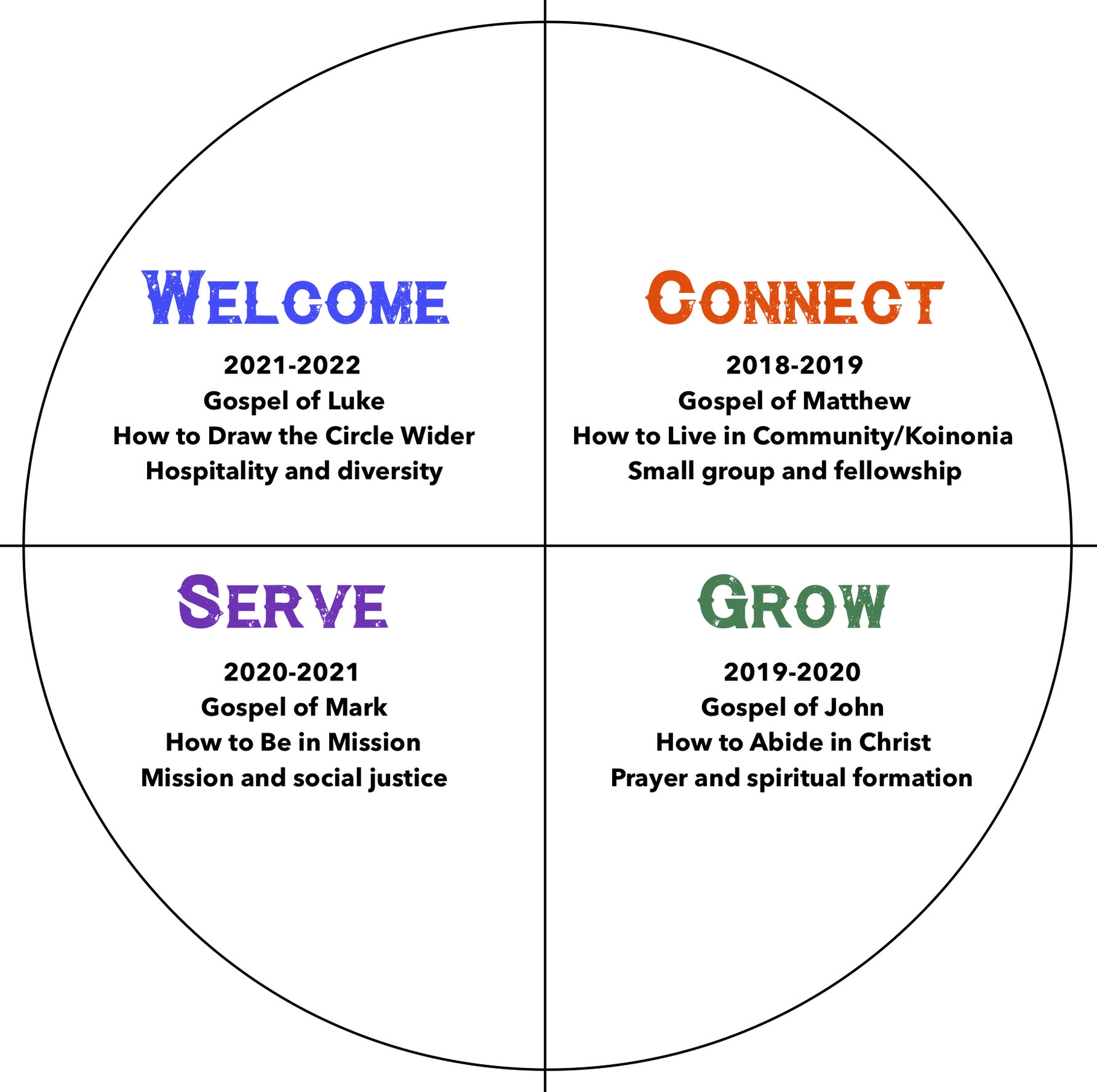
The new statement, adopted by the Church Council this summer, reads, “As disciples of Christ at Kessler Park UMC, we: Welcome all people, Connect with one another, Grow closer to God, and Serve the community.”

Those four words — Welcome, Connect, Grow, and Serve — form the basis of a discipleship path, or a kind of basic direction for adult training in discipleship. Since I’ve been appointed to KPUMC, I have been searching for a way to orient and align our programs and ministries to correspond with a clear discipleship path.

Put another way, I’ve been looking for language about how to invite people to follow Jesus, and then give them the tools to actually do so. I think these four words accurately sum up that path. First, we are welcomed into a faith community and experience hospitality; when we are comfortable, we seek to connect with some of the members of that community outside of the worship experience, usually in some kind of small group; as a result of this connection, we begin to grow spiritually and find ourselves getting closer to God through Jesus Christ; and as an expression of our gratitude to God, we develop our spiritual gifts and put ourselves into Christian service of others. Then we find ourselves welcoming new people into the community … and the process starts all over again.

At some point, I recognized that each of these four concepts correspond with one of the four gospels. Thus, the idea of being welcoming, hospitable and inclusive aligns neatly with the Gospel of Luke, which is focused on Jesus’ ministry to outsiders; the idea of spiritual growth fits with the Gospel of John, which is mystical and urges us to “abide with Christ.” The Gospel of Mark’s emphasis on radical discipleship points us toward service, and the Gospel of Matthew focuses on the new community and connections formed by the good news of Jesus.

I have decided, then, as your primary preacher and teacher, to focus on each one of the four gospels over the next four years, beginning with the Gospel of Matthew, and focusing on the key question that Matthew seeks to answer, “How does God intend for us to live together in community?”

To that end, I am creating a 24-week core course on Matthew which will be offered to all church Sunday School classes in September. The first 16 chapters of the book will be covered in the fall; the rest of Matthew will be covered in spring 2019. I will be writing a study guide with class instructions, and preparing a 5-7 minute video for each week’s lesson.

In addition, Wednesday Night Live adult classes will focus on the same theme. This fall, I will offer a class entitled“Reading Matthew with New Eyes” and Mike Smith will lead a study on community using the Nooma video series by Rob Bell. In the spring, I will offer a class on“The Sermon on the Mount.”

At this point, you may be wondering, “OK, but what’s the big deal? So we’re studying Matthew …” Here’s the exciting part: the Sunday School course and Wednesday night classes will all be offered online, as well as in person.

If you can’t be here on Sunday morning or Wednesday night, you can still participate in the learning, the discussion, the spiritual formation! And not only will you be able to participate, but people who are not currently members of our faith community can, too!

Everything that will be used in the class will be available online — the content, handouts, slides, videos, and discussion. I’m also planning to make additional content available online, including podcasts, interviews with Bible scholars, ebooks, and occasional live gatherings.

I’m calling this entire project “The Way.” That’s not an arbitrarily chosen name. Did you know that the first name for the new Jesus movement in the New Testament was “The Way”? Five times in the book of Acts, the movement is called “The Way,” including 9:2, 19:9 and 23, 24:14 and 22.

I love the name because it indicates that we are on a path, following a direction. We don’t have all the answers, nor do we live by a bunch of rules. We’re simply going to follow Jesus together on this way.

I can’t wait to get going … stay tuned for the details!