Methodists and Strangely Warmed Hearts

As we draw near the General Conference which will determine the future shape of the United Methodist Church, it would serve us well to reflect on the theological and spiritual legacy which John Wesley left us.

It would be easy to list all the good things that Methodism has done since the 18th century; from schools to hospitals, homeless shelters to civil rights movements, from UMCOR to UMW. However, all the good work that Methodists have done is really the fruit of the spiritual foundations that John laid.

As a young man, John was a perfectionist. He grew up under the strict watchful eye of his priest father and loving mother, and imbibed their piety and concern for good order. He wanted to be a good Christian, to the extent that he and his brother formed a “holy club” while students at Oxford. While his peers were enjoying the freedoms and excesses of university life, John and Charles Wesley spent their extra time in prayer, Bible study, visiting prisoners, and receiving communion in evening chapel services.

Once ordained as an Anglican priest, John took the opportunity to become a missionary to America. He took a post in Georgia, and started making plans to evangelize the Indians. But he discovered that his parishioners weren’t as interested in the Christian life as he thought, and he made virtually no inroads into Indian civilization. After a brief romance ended in bitter disappointment, John set sail for home, dejected and broken.

The months following his return were filled with anxious searching. John felt driven to lead a good, Christian life, but he worried that he simply wouldn’t be able to do so. He came face to face with his fragile psyche and soul.

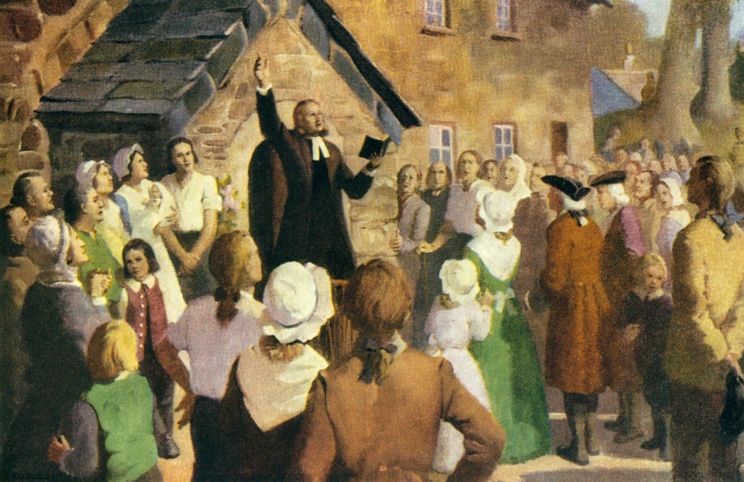
That’s why what happened on May 24, 1738 was such a pivotal moment for him. While at a Bible study somewhere on Aldersgate Street in London, John felt his heart “strangely warmed” as he came to a sudden realization: “I felt I did trust in Christ, Christ alone for salvation; and an assurance was given me that he had taken away my sins, even mine, and saved me from the law of sin and death.”

What happened that hadn’t happened before in John’s heart?

For one, John finally believed the gospel. He had “known” it before; he had even been ordained into the church, meaning that he assented to the church’s teaching and creeds. But he hadn’t really internalized it.

One way to put it is that the truth of God’s love and forgiveness was in his head, but hadn’t made the “longest six-inch journey” to his heart. He didn’t really act as if he believed it, until that fateful day.

Unfortunately, not all Methodists these days have come to a similar realization. Some Methodists have never made that journey from the head to heart, and that may be the fault of the institutional church, which tends to favor the head in most matters. Even our worship tends to be intelligence and knowledge-based. We sing from books, read prayers from bulletins, and assume a certain level of education.

I realized long ago that it doesn’t matter how many times I say, “God loves you and forgives your sins,” because some people don’t really hear it, don’t know what to do with it, don’t truly believe it. Until that becomes rooted in your heart, you won’t live the Spirit-filled life that is the birthright of us all.

Which brings me to a second thing that John Wesley gifted us. The Aldersgate experience taught John that he was not accepted by God as a result of all the good things he did, but was a free gift of grace. He also discovered that, suddenly, he was motivated to do good works as a response to God’s grace. And he found that grace was a free-flowing, ongoing gift.

He called the process of growing in grace, “sanctification,” and the doctrine of sanctification which he developed is one of the hallmarks of Methodism. For the rest of his life, John preached that we are made right with God by grace, and that this is not a one-time experience, but an ongoing process by which we draw closer and closer to God. He stressed the importance of staying close to each other for support and accountability, while also availing oneself of all the means of grace.

This message was radical for his time, and I believe that it remains radical, particularly in 21st-century America, which seems to inject a kind of individualistic, pull-yourself-up-by-your-own-bootstraps, punishment-and-reward ethos into all things, even religion.

As a result of John’s preaching, Methodists have been doing very good things for over 250 years. But it’s important to remember — we don’t do good things hoping that God will love us; we do them because we know that God already does, and we want to pass on the good news to others.

So my fellow Methodists, here’s the question that John leaves for each of us to answer: Do you trust in Christ, Christ alone for salvation; and do you have an assurance that he has taken away your sins, even yours, and saved you from the law of sin and death?
Facing the Un-Tied Methodist Church

st louis.jpg

Ignorance is not bliss. It’s not good to be unaware of what is happening.

That’s why I’m going to be blitzing you with information over the next few weeks about the General Conference of the United Methodist Church which is meeting in St. Louis from Feb. 23-26.

This could be an historic conference, a moment in which the United Methodist Church (UMC) as we have known it for fifty years will cease to be, or change in significant ways, or descend into further certainty.

The presenting issue is, of course, the church’s official stance on the inclusion of LGBTQ people in the full ministry of the church. According to the UMC’s Book of Discipline, our primary book of law, homosexuality is “incompatible with Christian teaching,” and therefore, same-sex weddings may not be performed by UM clergy nor take place in UM churches. Furthermore, “self-avowed, practicing homosexuals” may not be ordained.

Several years ago, Kessler Park UMC voted to align with the Reconciling Ministries Network and register its complaint with the church’s stance, though we have continued to live under, and abide by, the denomination’s rules.

At the church’s last big global gathering, the 2016 General Conference, attempts to change the language in the Discipline failed (again), and delegates began to talk openly of schism. In a desperate attempt to keep that from happening, delegates pleaded with the bishops to take an active role in leading the denomination forward. The bishops responded by proposing to form a commission with the sole task of exploring and recommending a plan to hold the denomination together in spite of the division.

This plan was adopted, the commission formed, the plan recommended, and now the church will meet to hear it and decide if it is truly the way forward for United Methodists. 

Of course, it’s a lot more complicated than that. For one, the commission forwarded three different plans to the bishops. The bishops ultimately chose one called the “One Church Plan,” but included in their report the other two plans. A number of dissenting bishops argued that all three plans ought to be considered by the General Conference, and their argument was upheld by the Judicial Council.

Here is a (too) brief summary of plans being presented to General Conference, including one which didn’t come from the bishops:

One Church Plan: This plan would allow local churches and clergy to decide for themselves whether they will perform same-sex weddings, and would allow annual conferences to decide whether they will ordained LGBTQ people, and would not impose penalties on either.

Connectional Conferences Plan: This plan would create three different large all-encompassing “connectional conferences” in the United States: a traditionalist conference, a moderate conference, and a progressive conference. Each local church and clergy person would decide in which conference they wanted to be included. 

Traditionalist Plan/Modified Traditionalist Plan: These plans would maintain the prohibitive language against homosexuality and put severe penalties in place for churches, clergy, and bishops who do not comply. All conferences, bishops and clergy would have to certify their adherence to the Book of Discipline or face expulsion.

Simple Plan: This plan removes all prohibitive language against homosexuality from the Book of Discipline. Simple! But unlikely to pass.

Last Monday night, I gave a more comprehensive summary of the plans, as well as a preview of the upcoming General Conference in my Facebook Live appearance. It’s still available for viewing on the Kessler Park UMC Facebook page.

I will be appearing on Facebook Live each of the next two Monday nights at 9 pm with updates and analysis of the General Conference. You’re invited to join me to hear what’s happening.

Also, I have added a new page on the church website with information about General Conference, including links to groups connected to each plan, and sources of news throughout Conference. I’ve also posted a link to the live stream so you can watch what happens in real time.

We’ll have the live stream broadcast in the Fellowship Hall on Tuesday all day, so you can come and watch with staff and other church members. Together we can watch, pray, and celebrate or mourn the proceedings.

On the Sunday after General Conference, you’re invited to stay after worship for lunch during which I will do an extended presentation on what happened and what it means for Kessler Park UMC. We might even be joined by a delegate who attended the meeting; stay tuned for details!

Finally, I want to sincerely ask that we engage in serious and intentional prayer before and during the conference. That’s why we have decided to have a prayer vigil; the meeting will last for a total of 82 hours across four days. We’re looking for people to sign up to pray for a total of 82 hours during that same time period. You don’t need to pray at the church; you can pray in the privacy of your own home at any time which is most convenient. But we do want to make sure that we have people praying for a total of 82 hours. To sign up for the vigil, click here. 

If you don’t know how to pray for an hour, or would like some guidance, Ken Kelley has prepared a guide to prayer which will be available this Sunday at worship, and will be posted to the website this weekend.

This is not a time to panic or become anxious; it’s a time to pray and to wait to see what God will do through the people called United Methodists, and through those of us who are part of Kessler Park UMC.

God Has No Point System

points.jpeg

The opening scene of the pilot episode of one of my current fave TV shows finds Eleanor (Kristen Bell) sitting on a couch in a waiting room staring at the words “Welcome! Everything is fine” painted on the wall opposite her.

A door to an inner office opens and a man in a blazer (Ted Danson) invites her in. They sit across a desk from each other, and he introduces himself as Michael. She responds by asking, “Where am I?”

Michael says that she is dead. “Your life on earth has ended, and you are now in the next phase of your existence in the universe.”

Eleanor answers, “Cool, cool. I have some questions … Am I … (pointing upwards) or is this … (pointing downwards)?”

“It’s not the heaven-or-hell idea that you were raised on,” Michael says. “But generally speaking, in the afterlife, there’s a Good Place and there’s a Bad Place. You’re … in the Good Place.”

Did I mention this is a comedy?

It doesn’t take long before the show’s central conflict reveals itself — Eleanor shouldn’t have been sent to the Good Place; she was actually a pretty terrible person on earth, and the only way to get to the Good Place is by accumulating a net positive amount of points. She is the first to realize this problem, and tries her hardest to keep from being “outed.”

What plays out over the next three years of NBC’s “The Good Place” is a hearty dose of ethics, smart metaphysical humor, and a sassy robot girl named Janet. Except she’s not really a robot, but … it’s complicated.

One of my favorite scenes is the orientation video produced for new arrivals to the Good Place. You can watch it above. I’m especially fascinated by the point system that the Good and Bad Places are based upon.

In the video, Michael explains:

During your time on earth, every one of your actions had a positive or a negative value depending on how much good or bad that action put into the universe. Every sandwich you ate, every time you bought a magazine, every single thing you did had an effect that rippled out over time and ultimately created some amount of good or bad … When your time on earth has ended, we calculate the total value of your life using our perfectly accurate measuring system. Only the people with the very highest scores, the true cream of the crop, get to come here, to the Good Place.

In “The Good Place,” going to heaven or hell depends on one’s final “score.” That might sound amusing, but it absolutely amazes me how many people live their real lives according to this reasoning. This kind of moral reckoning likely makes sense to lots of people. In fact, I would guess that a large percentage of Americans believe in heaven and hell, and most of them probably believe that the way to get to heaven is to accumulate more good actions than bad.

What shocks me even more is that so many Christians live this way, too. Throughout my career as a pastor, I have visited more than one person on their deathbed who has said to me, “I’m not worried about going to heaven. I know I’ve been a good person.”

I want to say to them, though I usually don’t say it as bluntly as this, that BEING A GOOD PERSON HAS NOTHING TO DO WITH HEAVEN OR HELL.

In fact, that’s the exact opposite of the good news of Jesus Christ. The core gospel message is that God loves us — period. We are all sinners, all flawed and broken, but God forgives us anyway, and not because of anything we have done, but on the merit of Jesus Christ’s advocacy on our behalf.

This was the central theological point of the Protestant Reformation. Martin Luther protested the clergymen who were traveling the countryside selling “good points” to folks to boost their chances of gaining heaven. Luther insisted that God didn’t work this way; we couldn’t earn our way to heaven, but could only rely on grace to get us there.

In other words, God has no point system.

Paul put it like this: “For by grace you have been saved through faith, and this is not your own doing; it is the gift of God — not the result of works, so that no one may boast. For we are what he has made us, created in Christ Jesus for good works, which God prepared beforehand to be our way of life” (Eph. 2:8-10).

The good news is that we are saved by grace, not by good works, but that we are created to be people who do good works. The good works are not a means to an end; they are the end themselves. They are what constitute a meaningful, purposeful life.

You are already loved, already saved, already held in the arms of God. Nothing can tear you from God’s arms, nothing can separate you from God’s love. You are secure.

You will be in the Good Place one day, along with everyone else.

But until then, let’s do everything in our power to make this planet, this earth, this nation, this neighborhood, God’s Good Place.

Join us at our next Faith on Tap session, Feb. 12, 7 pm at 723 Ft Worth Ave, as we take a deeper dive into “The Good Place” and what it means to be good.